



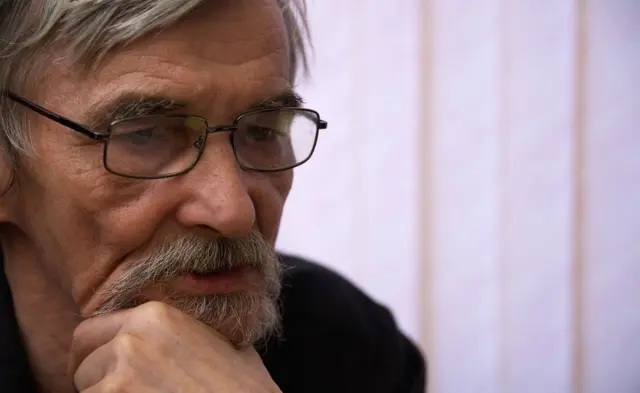
Today, Russian historian Yury Dmitriev marks his 70th birthday in a Russian prison. For nine years he has been deprived of his freedom under a fabricated criminal case — punishment, human rights advocates say, for his work preserving the memory of victims of Soviet state terror.
A researcher from Petrozavodsk, Dmitriev began in the late 1980s, together with historian Ivan Chukhin, to search for sites of mass executions. In 1997, Dmitriev and colleagues from the Memorial Society discovered the Sandarmokh memorial cemetery near Medvezhyegorsk, where more than 6,200 people were executed and buried. Dmitriev began compiling the lists of the executed together with Chukhin, who later died tragically.
Thanks to Dmitriev’s work, Sandarmokh became a site of international remembrance. Name plaques were installed, memorial crosses erected, and an access road built. On the Day of Remembrance for Victims of Political Repression, relatives of the murdered, human rights defenders, officials, and international delegations traveled there from different countries. It is precisely this work, according to human rights advocates, that triggered his persecution.
Criminal cases were brought against Dmitriev — first for the alleged “illegal possession of weapons,” and later for “production of pornography.” The latter charge was based on medical photographs of his adopted daughter, taken by Dmitriev in his role as guardian for doctors to monitor her health. Twice, courts fully acquitted him. However, after repeated appeals by the prosecution and pressure placed on the child, the charges were reclassified as “sexual acts.” Dmitriev was ultimately sentenced to 15 years in prison, his family was destroyed, and he was stripped of custody of the child.
There is a widely shared view that the case was an act of retaliation for Dmitriev’s publication of the names of NKVD officers involved in mass executions. At the same time, officials have promoted an unproven narrative claiming that Sandarmokh was the site of alleged “Finnish executions,” attempting to replace historical truth with a politically convenient version.
Today, Yury Dmitriev is held in a penal colony in Mordovia. He is seriously ill, severely weakened, and hopes for a possible exchange, though the nature of the charges makes this prospect extremely remote. Even so, he continues to resist injustice from behind bars. In a recent letter from the Potma prison camp, he wrote to his supporters:
Let us hope that the new year will bring more radical change than the one that has passed…
These changes are awaited not only by his family and friends, but by the entire democratic community, for whom the memory of state terror remains a matter of human dignity.
Freedom for Yury Dmitriev!