



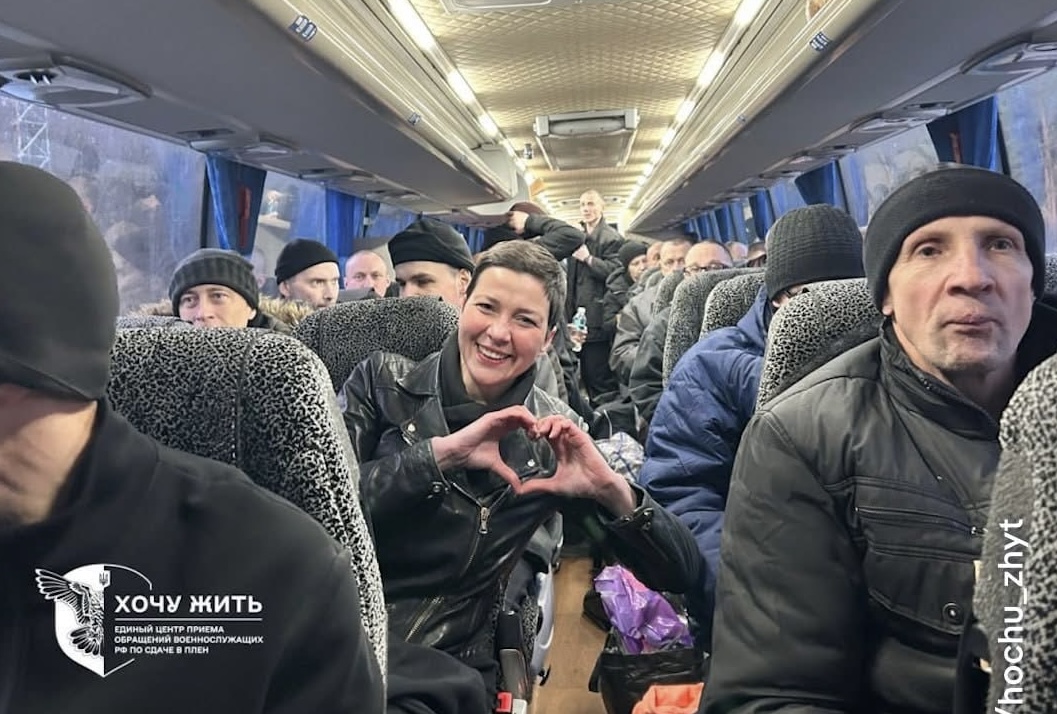
Belarusian authorities have released 123 political prisoners, including key figures of the 2020 mass protests. The releases took place amid reported agreements between the Belarusian authorities and the administration of U.S. President Donald Trump and coincided with the lifting of U.S. sanctions on Belaruskali, one of the world’s largest producers of potash fertilizers. The sanctions had been in place since 2021.
The majority of those released — 114 people — were immediately taken out of Belarus, primarily to Ukraine. In recent years, the authorities have systematically applied a practice amounting to forced exile: political prisoners are released but not allowed to remain in the country and are instead forcibly transported abroad. This time, the evacuation route was changed at the last moment, and the Ukrainian side had not been prepared in advance to receive the released individuals. Despite this, Ukrainian authorities quickly mobilized to provide accommodation and assistance.
Among those released is Maria Kolesnikova, one of the leaders of the 2020 protests, who spent 1,808 days in detention. Shortly before her release, she was transferred from a penal colony to a pre-trial detention center. According to Belarusian human rights defenders, Kolesnikova was taken to Ukraine. After her release, she said she felt immense happiness but was thinking of those who remain imprisoned and was waiting for the day when all political prisoners would be able to see and embrace one another.
Viktor Babariko, former head of Belgazprombank and a key challenger to Alyaksandr Lukashenko in the 2020 presidential election, was also released. He was detained two months before the vote. Kolesnikova had served as coordinator of his campaign headquarters and later became one of the most prominent symbols of the protest movement. After the election, both were sentenced to lengthy prison terms and held in incommunicado detention, without contact with the outside world. Maksim Znak, another member of Babariko’s campaign team, sentenced in 2021 to ten years in prison, was also released.
Ales Bialiatski, head of the Belarusian human rights center Viasna and a 2022 Nobel Peace Prize laureate — awarded jointly with Russia’s Memorial and Ukraine’s Center for Civil Liberties — has also been freed. Bialiatski was detained in the summer of 2021 and sentenced to ten years in prison on charges related to supporting the 2020 protests. He received the Nobel Peace Prize while in custody. After his release, he was taken out of Belarus.
Also among those released is Marina Zolotova, editor-in-chief of Tut.by, the country’s largest independent media outlet, which was shut down by the authorities in 2021. She had been sentenced to twelve years in prison. At the same time, Tut.by’s director Liudmila Chekina remains behind bars.
Others released include political analyst Alexander Feduta, opposition politician Pavel Seviarynets, five Ukrainian citizens, as well as citizens of Japan, Lithuania, Latvia and the United States. At the same time, Eduard Babariko, the son of Viktor Babariko, remains imprisoned, as does journalist and leader of the dissolved Union of Poles in Belarus, Andrzej Poczobut.
According to the human rights center Viasna, more than 1,200 political prisoners remain behind bars in Belarus. Since 2020, more than 7,000 people have been convicted in politically motivated criminal cases. Despite the release of some detainees, human rights defenders stress that the repressive system in Belarus remains in place and that releases continue to be selective and driven by political considerations.